
SMILE-FX / Miramar / Understanding a supplied explanation
Understand an impacted-canine explanation
A tooth can be present without having come through the gum. Follow one fictional clinician explanation to picture the named upper canine and understand the different jobs in its proposal.
This chapter is for a young person and parent already given this finding by a clinician. The example supplies the finding; a gap or an unseen tooth alone cannot identify it.
Present and erupted answer different questions
Present concerns whether the tooth is there. Eruption concerns its coming through into the mouth. Impaction describes absent or partial eruption. These words describe different properties: an unerupted tooth is not automatically an absent tooth.
Vocabulary: AAO orthodontic glossary. The individual's finding comes from their clinician.
Maya's fictional clinician explanation
Maya and her parent have been told: “The upper canine we identified is present and impacted. It has not come through the gum. It lies on the roof-of-mouth side behind the upper front row. In this proposal, the oral surgeon's exposure contribution is intended to help it erupt. The orthodontist's contribution concerns guiding its eruption and position in the row, with orthodontic review.”
Maya, the conversation and the proposal are invented for this lesson. The two named roles belong to this fictional proposal.
Maya's explanation answers the presence question positively. “Has not come through” describes eruption status, rather than saying the tooth never developed or is already missing.
Put that same tooth beside its supplied location
“Roof-of-mouth side behind the upper front row” places Maya's named canine to the inner side of the row. “Has not come through the gum” adds a separate relationship to the gum boundary. Both statements concern the same present tooth.
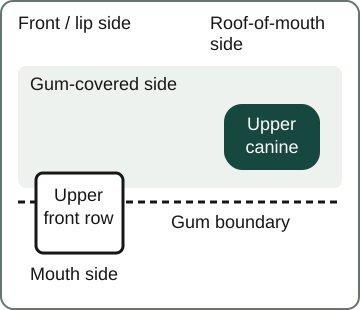
The canine marker is behind the row marker, rather than a blank interval inside the row. That is the physical distinction the supplied words explain; the picture does not locate a reader's tooth.
Location context: Cambridge University Hospitals upper-canine information and Hull University Teaching Hospitals upper-canine information. These hospital leaflets describe their own patient contexts.
Separate the proposal's purposes and responsibilities
The exposure contribution
In Maya's supplied proposal, the oral surgeon has the exposure role. Its stated purpose is to help the named tooth erupt. This explains what that contribution is for, without supplying a procedure to follow.
The orthodontic contribution
The orthodontist's stated job concerns guiding eruption and positioning that same tooth in the row, with orthodontic review. A purpose describes what care intends to address; it does not report that eruption or positioning has been achieved.
These different jobs make sense together in this proposal. The finding alone does not select this proposal for someone else. The hospital information does not establish a SMILE-FX exposure service, referral partner or care arrangement.
The completed reading
Maya's upper canine is there, but has not come through the gum. Its supplied position is behind the upper front row on the roof-of-mouth side, under the gum. The proposal gives exposure an eruption purpose and gives orthodontic care an eruption-and-positioning purpose with review. It names different responsible roles for those contributions. None of those statements reports a finished result.
That is a complete retelling of what Maya was told. For your own explanation, the actual clinicians supply the finding, recommendation and personal arrangements. Your questions matter alongside your parent's; understanding an explanation does not require agreeing to it immediately.
Bring an understandable explanation to the conversation
At SMILE-FX, board-certified orthodontists see every patient, including follow-ups, within full-service orthodontics with a digitally driven clear-aligner focus. The useful connection here is discussing the individual explanation with the responsible clinician. Braces or aligners do not select an approach from this chapter.
Read the complete doctor-led care model, return to mixed dentition and assessment, or revisit findings, goals and appliances. For a current treatment question, use the contact route supplied by the team managing that care.
Prepared for SMILE-FX with AI assistance. Bounded educational sources checked October 24, 2026. No named clinician review is claimed.